TL;DR
A practical employer playbook for hiring remote staff in South Africa without avoidable legal or operational mistakes.
Compare entity setup, EOR, and contractor models with clear cost and risk tradeoffs.
Use a 30/60/90 implementation plan and KPI scorecard to hire faster and retain better talent.
Table of Contents
- How do I hire remote staff in South Africa from another country?
- Do I need a legal entity to hire remote staff in South Africa?
- What are the compliance and payroll requirements for South African remote staff?
- How much does it cost to hire remote staff in South Africa?
- How can employers reduce hiring risk and turnover with South African remote staff?
- South Africa hiring readiness score (before opening a role)
- First-90-day economics model for remote staff hiring
- Payroll and compliance failure modes (and how to prevent them)
- Country launch operating map: from first hire to stable pod
- Employer review packet for monthly leadership updates
- Two employer launch snapshots (what good execution looks like)
- Final thoughts
If you want to hire remote staff in South Africa, the opportunity is real: strong English communication, broad role coverage, and attractive cost structure compared with many US and UK hiring markets.
But most employer mistakes happen before the first day of work. Teams rush into hiring without choosing the right model, skip compliance planning, and then patch process gaps while trying to scale. That creates friction, turnover, and unnecessary legal risk.
This guide is the employer-first operating playbook. You’ll get a clear path for model selection, compliance setup, budget planning, onboarding, and risk control—so you can build a reliable team instead of a fragile one.
If you’re deciding between legal models first, start with Hire South African Remote Contractors vs Employees (2026): Cost, Risk, and Compliance.
How do I hire remote staff in South Africa from another country?
Snippet answer: Start by defining role scope and selecting the legal hiring model before recruiting. Then run a structured workflow: role brief, sourcing, interview scorecards, compliance setup, contract issuance, onboarding, and 30-day quality checks. Hiring speed comes from operating discipline, not shortcuts.
Most employers fail by flipping this order. They start by sourcing candidates, then debate classification and payroll after offer stage. Do it in the opposite sequence.
Step-by-step employer workflow
-
Define role outcome and ownership
Clarify what success looks like in 30, 60, and 90 days. -
Choose the hiring model
Decide contractor vs employee vs EOR before you interview. -
Set compensation band and total-cost ceiling
Budget for compensation plus tools, oversight, and compliance admin. -
Build interview scorecard
Evaluate communication quality, execution reliability, and role-specific skills. -
Run compliance preflight
Confirm contract template, data handling standards, and payroll pathway. -
Issue offer and documentation stack
Keep terms clear on scope, expectations, and reporting cadence. -
Launch onboarding with ownership
Assign one manager accountable for ramp and output quality. -
Conduct 30-day performance and model check
Verify if role design and legal model still align with reality.
Practical hiring timeline (realistic)
- Week 1: role design + model decision + scorecard
- Week 2: sourcing + interviews + shortlist
- Week 3: offer + documentation + onboarding prep
- Week 4: start date + SOP handoff + KPI tracking
High-urgency hires can move faster, but only if you already have templates, approval lanes, and hiring ownership locked.
Do I need a legal entity to hire remote staff in South Africa?
Snippet answer: Not always. You can hire remote staff through a local entity, an Employer of Record (EOR), or a contractor arrangement depending on role type and control needs. If you need long-term employee structure without opening a local company, EOR is often the fastest compliant option.
There are three practical models:
1) Local entity hiring
Use when:
- you have significant headcount plans in South Africa,
- you need deep in-country infrastructure,
- you can absorb setup and ongoing administration.
Pros:
- direct employment control,
- long-term strategic footing.
Tradeoffs:
- slower setup,
- higher administrative burden,
- more internal legal/finance coordination.
2) EOR hiring
Use when:
- you want employee structure fast,
- you do not want to create a local entity yet,
- you need predictable compliance operations now.
Pros:
- faster compliant setup,
- reduced administrative friction,
- strong fit for growth-stage global teams.
Tradeoffs:
- additional service fee,
- requires clear internal owner for day-to-day performance management.
3) Contractor engagement
Use when:
- role is scoped, project-based, and output-led,
- operational control is lower,
- duration is intentionally flexible.
Pros:
- speed and flexibility,
- lower fixed overhead.
Tradeoffs:
- higher misclassification exposure if role drifts into employee-like setup.
Model selection rule most employers should use
- Core, long-term, manager-led roles: employee or EOR employee.
- Project-bound, independent roles: contractor.
Don’t pick model based on convenience alone. Pick based on role reality.
What are the compliance and payroll requirements for South African remote staff?
Snippet answer: Compliance requirements depend on your hiring model, but all models need clear contracts, data handling controls, and auditable process discipline. Payroll setup must match legal classification. The biggest risk comes from mismatch between contract terms and day-to-day operating behavior.
This is where many teams underprepare.
Compliance fundamentals every employer should cover
- Written agreement that matches actual operating model.
- Defined responsibilities for manager, HR, and finance stakeholders.
- Data confidentiality and system access controls.
- Clear escalation rules for role changes or scope expansion.
- Quarterly model-fit review to detect drift.
Payroll and admin controls
For employee/EOR models, establish:
- payroll calendar and owner,
- documentation standards,
- approval workflow for comp changes,
- reconciliation process for monthly costs.
For contractor models, establish:
- invoice cadence,
- acceptance criteria for deliverables,
- payment approval workflow,
- documentation archive for auditability.
Misclassification prevention in real teams
Misclassification usually starts as a management behavior problem:
- adding fixed hours and high daily process control,
- making the person operationally exclusive over time,
- treating project support as permanent employment while keeping contractor paperwork.
Your prevention system should include two hard gates:
- Role-change trigger: if scope becomes permanent/core, force classification review.
- Quarterly audit: check whether manager behavior still matches contract model.
If not, convert early. Waiting is what creates expensive cleanup.
How much does it cost to hire remote staff in South Africa?
Snippet answer: True cost includes more than salary. Employers should budget compensation, platform/admin fees, management overhead, tooling, and quality-adjusted risk. Teams that only optimize for headline pay often lose money through rework, churn, and delayed execution.
Use effective cost, not just monthly pay
Effective Monthly Cost = Compensation + Admin/Platform + Tooling + Oversight + Risk-Adjusted Rework Cost
That final term—risk-adjusted rework—explains why “cheap hire” can become expensive fast.
Budget examples (illustrative framework)
Scenario A: Support role, clear SOPs
- Moderate complexity
- Strong process environment
- Predictable quality ramp
Typical outcome: stable effective cost and lower management burden after first month.
Scenario B: Complex role, weak process setup
- Vague ownership
- No quality standards
- Frequent priority changes
Typical outcome: lower headline pay but higher hidden cost through rework and manager time.
Scenario C: Growth-stage multi-role expansion
- Hiring 3–5 roles over a quarter
- Need fast but compliant scaling
Typical outcome: model consistency matters more than individual salaries. Standardized onboarding and reporting reduce cost volatility.
Cost controls that actually work
- Define one compensation philosophy per role band.
- Standardize onboarding and quality checkpoints.
- Use 30-day and 90-day fit reviews.
- Track manager oversight hours as a cost metric.
- Optimize for retention, not only hiring speed.
Retention is a direct cost lever. Rehiring the same role repeatedly destroys forecast accuracy.
How can employers reduce hiring risk and turnover with South African remote staff?
Snippet answer: Risk and turnover drop when employers treat hiring as an operating system, not a one-time recruitment event. Use clear role ownership, structured onboarding, measurable KPIs, and early intervention on quality or model-fit drift.
Most turnover is preventable process failure, not market failure.
30/60/90 execution plan
Days 1–30: foundation
- lock role outcomes and reporting lines,
- complete onboarding and SOP coverage,
- define first-month output targets,
- run weekly manager check-ins.
Days 31–60: stabilization
- measure quality pass rate and rework,
- tune workflow bottlenecks,
- adjust role boundaries if execution is noisy,
- verify classification still matches reality.
Days 61–90: scale readiness
- evaluate retention risk signals,
- codify role playbook,
- identify what can be delegated safely,
- approve scale only after stable KPI performance.
KPI scorecard for hiring health
Track monthly:
- time-to-hire,
- ramp-to-productivity,
- first-pass quality rate,
- rework percentage,
- manager oversight hours,
- 90-day retention,
- compliance incidents.
A clean signal pattern is simple: quality up, rework down, oversight hours down, retention stable.
Common mistakes and better alternatives
Mistake 1: Hiring before model decision
Fix: role-model decision first, sourcing second.
Mistake 2: Weak onboarding ownership
Fix: assign one accountable manager and one ramp plan.
Mistake 3: No early performance instrumentation
Fix: start KPI tracking week one, not month three.
Mistake 4: Treating compliance as paperwork only
Fix: audit operating behavior, not only contracts.
South Africa hiring readiness score (before opening a role)
Before recruiting, score your internal readiness out of 20. This catches process debt that usually gets blamed on candidates later.
Score 0–4 in each category:
- Role clarity: outcomes, ownership, and boundaries are documented.
- Model clarity: contractor vs employee/EOR decision made with rationale.
- Manager readiness: one owner accountable for onboarding and quality.
- Process maturity: SOPs, escalation path, and reporting rhythm defined.
- Measurement readiness: KPIs and review cadence already set.
Interpretation:
- 16–20: ready to hire.
- 11–15: hire possible, but expect slower ramp.
- 0–10: fix operating gaps first; rushing will create churn.
This score is more predictive of first-90-day success than interview confidence.
First-90-day economics model for remote staff hiring
Many teams track only salary and miss the real economics of remote team buildout.
Use this 90-day lens
90-Day Hiring ROI = Value of Output Delivered - (Compensation + Onboarding Cost + Oversight Cost + Rework Cost + Delay Cost)
If you don’t model oversight and rework, you’ll systematically overestimate ROI.
Why this matters
Two hires with similar monthly pay can have opposite 90-day economics:
- Hire A delivers slower but cleaner output with low rework.
- Hire B is cheaper upfront but needs heavy correction and manager time.
Hire A often wins financially despite higher nominal pay.
What to measure weekly during first 90 days
- output completed vs planned,
- first-pass quality,
- rework categories,
- manager hours consumed,
- blocker resolution time.
These are leading indicators of whether hiring economics are improving or deteriorating.
Payroll and compliance failure modes (and how to prevent them)
Most employer pain comes from a small set of repeatable operational failures.
Failure mode 1: model mismatch at launch
Role is run like full-time employee, but documented as contractor.
Prevention: run model-fit check at day 30 and day 60 with explicit reclassification triggers.
Failure mode 2: fragmented approval ownership
HR, ops, and finance each assume someone else owns critical approvals.
Prevention: assign one accountable owner per lane:
- hiring decision owner,
- payroll/admin owner,
- performance quality owner.
Failure mode 3: weak documentation hygiene
Critical changes are discussed in chat but never logged formally.
Prevention: enforce one source of truth for:
- agreements,
- role changes,
- compensation changes,
- escalation outcomes.
Failure mode 4: delayed escalation culture
Managers keep “coaching quietly” while quality risk compounds.
Prevention: use escalation thresholds tied to metrics (for example repeated SLA misses or rising rework).
Country launch operating map: from first hire to stable pod
This post is about employer execution, so here is the practical expansion map.
Stage 1: single-role launch
- goal: prove role-model fit,
- risk: overloading one hire with unclear scope,
- control: weekly review + strict task prioritization.
Stage 2: two to three role pod
- goal: separate execution and coordination responsibilities,
- risk: overlap confusion,
- control: role interface map (who owns what handoff).
Stage 3: repeatable country lane
- goal: make South Africa hiring a stable capability,
- risk: inconsistency across managers,
- control: shared onboarding playbook + monthly cross-role calibration.
This staged map helps you scale deliberately instead of “adding headcount and hoping.”
Employer review packet for monthly leadership updates
Replace generic status meetings with one monthly packet.
Include:
- Team snapshot (roles, model type, tenure)
- Cost snapshot (budget vs actual)
- Quality snapshot (first-pass, rework, SLA)
- Risk snapshot (model drift, compliance flags, retention)
- Decisions needed (keep, adjust, convert, or pause hiring)
This keeps hiring strategy aligned with business outcomes and avoids reactive decisions.
Two employer launch snapshots (what good execution looks like)
Snapshot A: founder-led services team
A services company hired one South Africa-based operations coordinator to reduce founder admin load. They defined scope well but skipped KPI instrumentation in week one. By week three, they felt “busy but not clearer.”
They corrected quickly: added weekly output tracking, clarified acceptance criteria, and cut low-priority tasks from the first-month scope. Within 30 days, manager oversight hours dropped and handoff speed improved.
Lesson: role clarity without measurement still creates ambiguity. Add metrics immediately.
Snapshot B: growth-stage ecom support pod
An ecommerce team launched two remote staff roles at once (customer support ops + catalog ops). They had clean SOPs but unclear decision ownership between ops lead and founder. Small delays compounded.
After assigning one accountable owner and introducing a monthly leadership packet, escalations became faster and output quality stabilized. They expanded to a third role only after rework stayed low for two consecutive cycles.
Lesson: ownership clarity is a growth control, not a management preference.
Final thoughts
Hiring remote staff in South Africa can be a strong growth lever for employers who run the process with discipline. The upside is clear: access to capable talent, meaningful cost efficiency, and scalable operating capacity.
But outcomes depend on execution. Pick the right model for the role, install compliance and onboarding controls early, and measure what matters from week one.
If you’re building your South Africa hiring motion now, pair this guide with Hire South African Remote Contractors vs Employees (2026): Cost, Risk, and Compliance, How to Hire Remote Talent Without Recruiting Fees, and Virtual Assistant Onboarding Checklist for 2026 so your next hires are both faster and more stable.
Explore related hiring options
Useful next pages based on this article's topic:
- Hire South African virtual assistants — core service page for evaluating HireSava's hiring model and next-step CTA
- Fluent English remote workers in South Africa — proof of communication quality for customer-facing and judgment-heavy roles
- South Africa virtual assistant cost guide — budget planning and quality-adjusted cost expectations
- South Africa VA rates benchmark — role-by-role compensation ranges and seniority bands
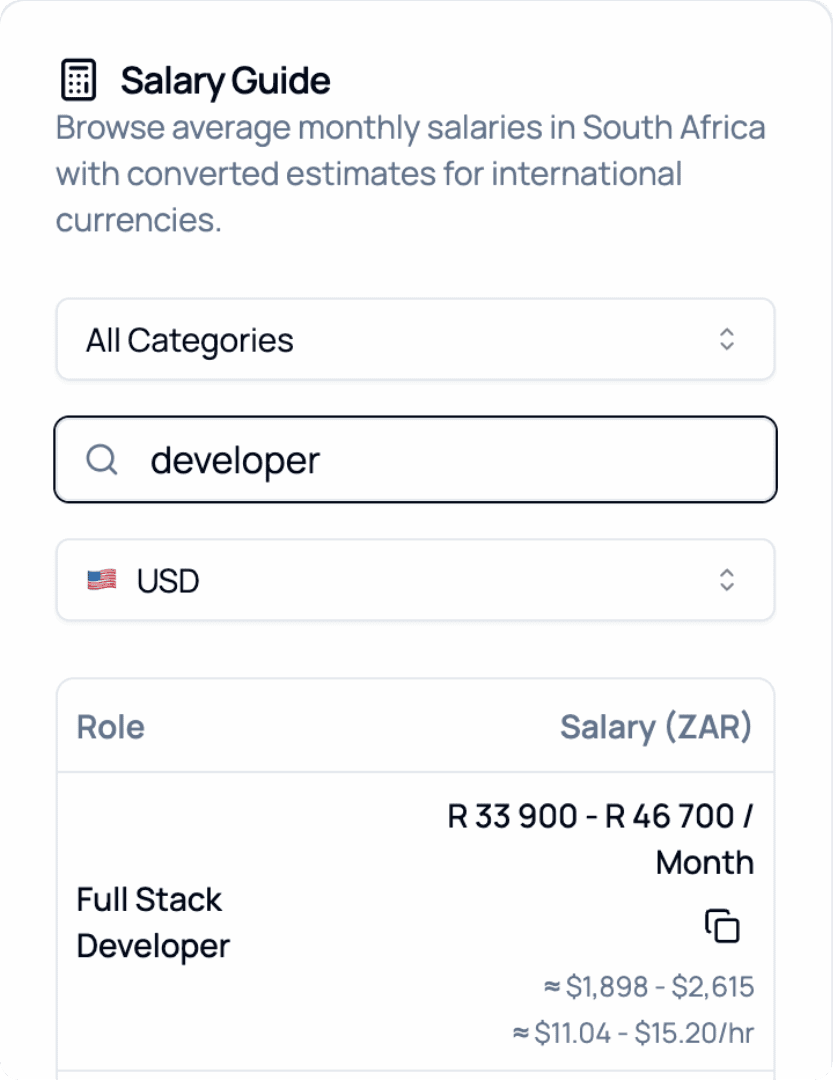
2026 Salary Guide: South Africa
Discover South African Salaries by Role. Compare costs and see how much you can save.